Anonymous Households
In many cases, Contact duplicates have independent Accounts/Households associated which are also duplicated.
In Salesforce, when duplicate Contacts are merged, the Account/Household from the non-master record is very often left empty (without any Contacts associated). When using NPSP, if there are no Contacts associated, the Account/Household is automatically renamed to ‘Anonymous Household’.
See more details here.
When this happens, a number of orphaned Accounts/Households remain in the org, and finding a way to eliminate them (via merge or mass delete) after the Contact merges have been completed is necessary. This can be a challenge if the Account/Household lacks data to easily identify matches other than the Account/Household Name. Sometimes the Contact record contains the majority of the data and would help to identify the Account/Household matches (rather than matching data on the Household itself).
Cloudingo offers a hybrid merge that will automatically merge the Accounts/Households associated with the Contacts being merged so that both objects are being merged simultaneously (avoiding the empty Account post-Contact merge).
Merging Duplicate Contacts in Salesforce
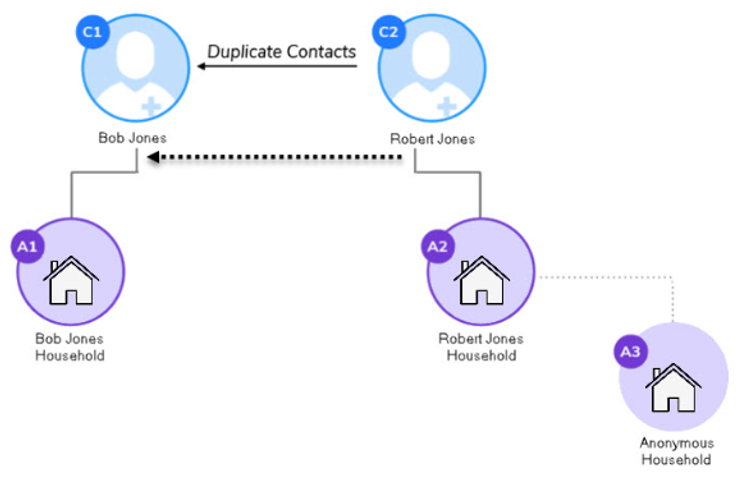
(Fig. 1) In Salesforce, when duplicate Contacts are merged that have separate Households, the associated Households are merged separately.
In this example, the master Contact (C1) is associated to a Household (A1) and the non-master Contact (C2) is associated to a different (but also duplicate) Household (A2).
The non-master Contact (C2) merges into the master Contact (C1). The master Contact record's Account is retained (A1). The non-master Contact record's Account is disassociated and left without any Contacts (A2).
Salesforce NPSP recognizes the empty Account (no Contact records) and to Anonymous Household.
Merging Duplicate Contacts Using Cloudingo Hybrid Merge (Hybrid Filter)
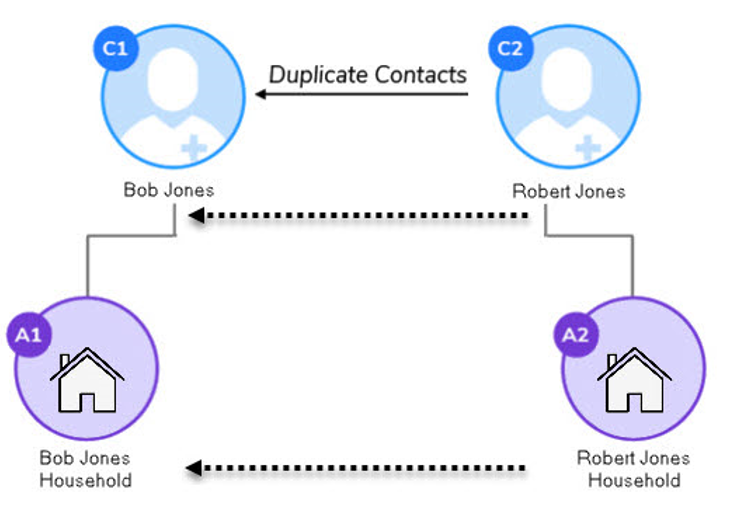
(Fig. 2) In Cloudingo, if the hybrid merge feature is enabled, the duplicate Accounts/Households are automatically merged when the Contact duplicates are merged.
In this example, the Contact non-master record (C2) merges into the Contact master record (C1). At the same time, the Contact non-master record's Account (A2) merges into the Contact master record's Account (A1). Cloudingo performs both the Contact & Account merges simultaneously, avoiding empty Accounts without Contacts associated when the Contact merge is performed.
Before Enabling Hybrid Merge (Hybrid Filter)
Please review before enabling.
Cloudingo Hybrid Merge Overview
Cloudingo’s Hybrid Merge feature allows account records directly associated with duplicate contacts to be merged as part of the contact merge process. This functionality was developed primarily for the non-profit and B2C sectors, where contacts are typically linked to household accounts rather than business accounts.
While there are scenarios in B2B environments where Hybrid Merge can be beneficial, users should carefully review their data model and operational processes before enabling this feature.
Risks and Considerations
Before requesting and using Hybrid Merge, please review the following points carefully:
- Contact-Based Grouping
- Hybrid Merge determines which records to merge based solely on contact matches.
- Contacts are grouped based on matching contact field values, and any related accounts within those groups are included in the merge.
- There is no matching logic applied to account fields. If multiple accounts are linked to the grouped contacts, those accounts will be merged.
- Filter Exclusions
- If your org uses business accounts or generic accounts (e.g., placeholders for contacts without households), ensure these are fully excluded from your Hybrid Merge filters.
- Master Account Selection
- In an account merge triggered by Hybrid Merge, the master account is automatically the one associated with the master contact in the contact merge.
- Optionally, Cloudingo can enable a setting that determines the master account based on an Account Automation Rule. This option must be requested and enabled by the Cloudingo team.
- Undo/Restore Limitations
- Cloudingo’s Undo/Restore feature is not supported for filters using Hybrid Merge.
- Merged records may have issues with restoration once merged via Hybrid Merge (success or failure will depend on the org's object relationships).
- Undo/Restore can still be enabled, and backups will be accessible for download in CSV format.
- Permissions
- There is no specific permission control for Hybrid Merge.
- In multi-user Cloudingo environments, any user with rights to create or edit filters can create a Hybrid Merge filter.
Enabling hybrid merge comes with some risks and considerations. We recommend testing it out with test records and/or in a Sandbox first.
Enabling Hybrid Merge (Hybrid Filter)
If the Cloudingo license already includes the ability to enable hybrid merge, simply edit the filter(s) to apply the hybrid merge.
- Navigate to the 'Tools' → 'Dedupe' → 'Filters' option from the left-hand-side navigation window.
- Choose the desired Contact filter's menu option and choose 'Edit'.
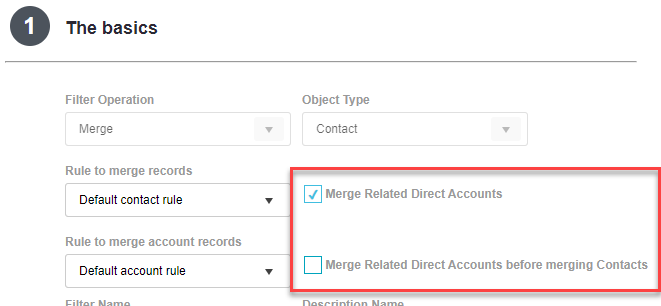
- Choose the 'Merge Related Direct Accounts' option in Step 1 of the filter configuration. Contacts will merge immediately prior to the Accounts.
- In some rare cases, merging Accounts before Contacts may be necessary to achieve the desired outcome.
- Enable the 'Merge Related Direct Accounts before merging Contacts' setting in addition to the 'Merge Related Direct Accounts' setting.
- In some rare cases, merging Accounts before Contacts may be necessary to achieve the desired outcome.
- A second rule option becomes available where the default 'Rule to merge account records' can be assigned.
- The rule chosen will determine how specific field rules get applied during the Account merge. The master Account chosen will always be the master Contact's Account (by default).
- To have the rule determine the master Account instead, contact the Support Team to enable a setting to control this (server side only).
- The rule chosen will determine how specific field rules get applied during the Account merge. The master Account chosen will always be the master Contact's Account (by default).
- Repeat these steps for any additional Contact filters to enable the hybrid merge.
- Be sure to test! We recommend testing it out with test records and/or in a Sandbox first.
- Licensing limits may apply.
- The feature must be enabled by Cloudingo before being utilized.
Videos
Note: Videos are shown using the Old UI but concepts are the same.